The Descent
By Jeremy Aitken
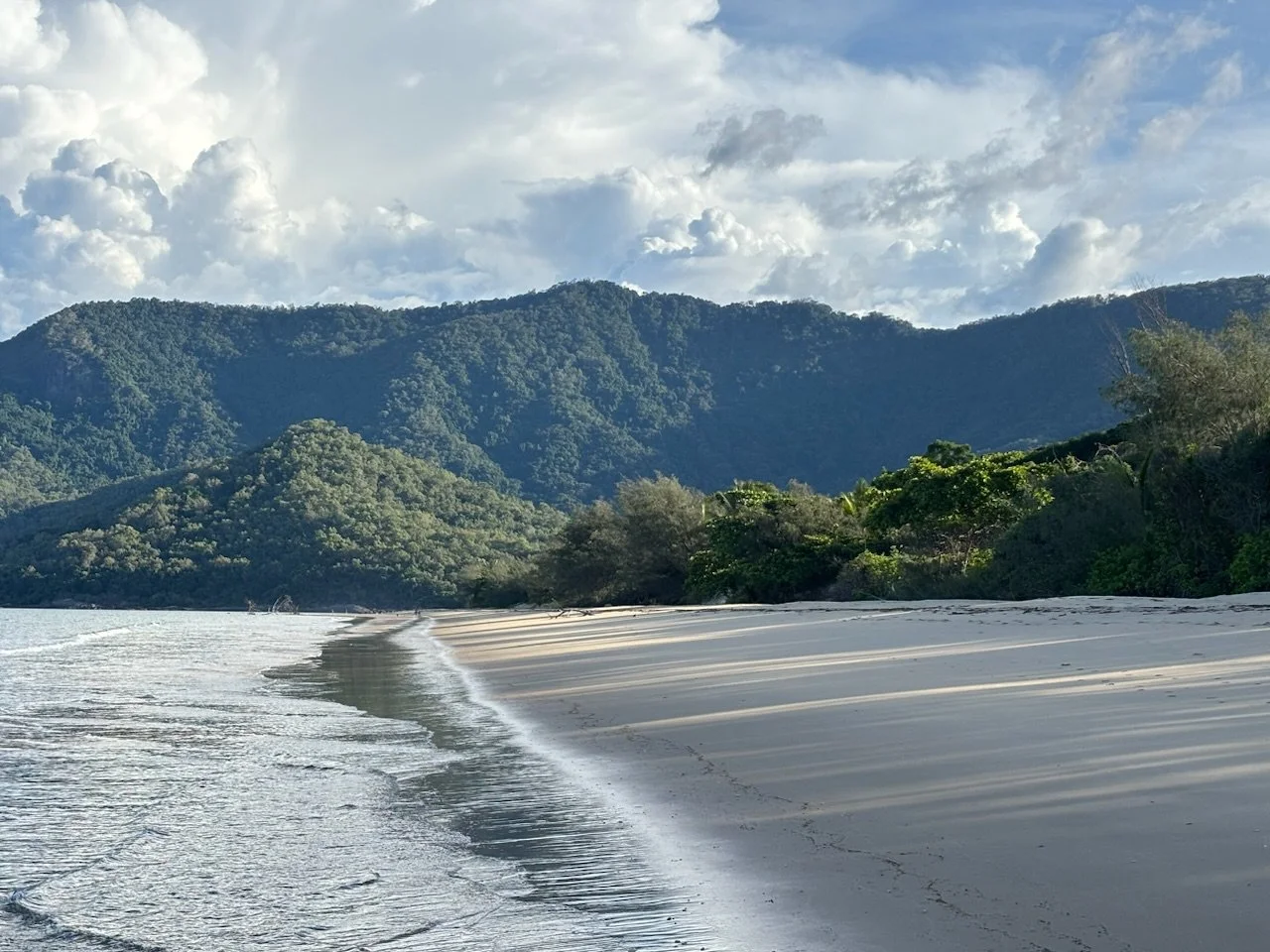
The road to Kuranda was a climb through fog and memory. Each bend rose steeper, the air thickening with green. Below me, Cairns lay ringed by mountains shaped like sleeping dragons, their spines lost in cloud. Driving upward felt like entering the belly of one.
‘The cave you fear to enter holds the treasure you seek.’
It took three days to reach the ridge. I left the day after the Uni term finished in December 2024 and drove the old Kia north with boxes of manuscripts stacked to the roof, caffeine and ghosts for company. The coastal road from Brisbane to Cairns was closed due to flooding, so I took the inland route, through the belly of Queensland, dry, flat cattle country, road-trains thundering past, cheap motels that smelled of bleach and rain, televisions hissing static. Maintenance men told me this was normal. I told myself I was leaving Sydney behind - the exhaustion, the glare of screens, the failed marriage, the constant hum of memorising corporate scripts, the mirroring, that sounded like living, until it stopped.
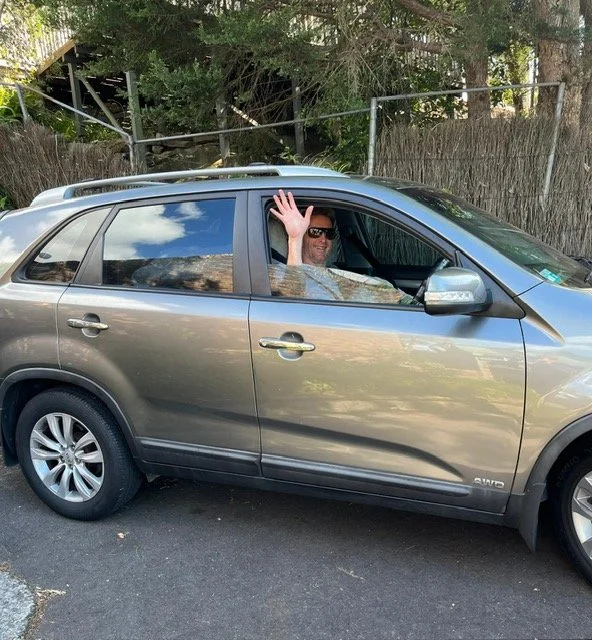
Ninety kilos lighter, sober for the first time in years, I no longer recognised the man in the mirror. The armour was gone, but so was the shape beneath it. I hadn’t written since Crystal Street was published in 2017. Could I still write? Could I do it sober? The question repeated with the rhythm of tyres on bitumen. Somewhere north of Townsville, Emerald, I think, the light began to change. The tropics started rumbling and the rain started to fall.
As I drive, the ghosts of my past come back to me. In 2005, at thirty-five, I was a writer who loved drugs and alcohol. Impulsive, restless, always chasing. I had the habits of a great genius. Every thought, every action aimed at keeping the crash away, regulating emotions, and silencing the voices.
By July 2016, I was 170 kilos. Bloated on painkillers, benzos and booze. My knees ached. My back throbbed. Walking was hard. I sweated constantly. I couldn’t shit properly, couldn’t wipe my own arse. My trip to Japan was the reckoning. In a mirror, I saw what I’d become: grotesque, lumbering, trapped in my own skin.
The airline tray table that wouldn’t fold down over my stomach. Two seatbelts clipped together around me. Knees screaming in pain as I walked through Kyoto. The Doctor said: surgery or death. So I did it. Gastric surgery.
The bypass carved me into someone I didn’t know. Thin, raw, cold. I woke up at night, every four hours, to take more drugs. Dehydrated, sick, clothes slipping off me. I looked at myself but didn’t recognise the body. I mourned the fat man - the drunk, the performer who could eat and drink and swagger. Thin, loose-skinned, freezing, I didn’t know the script, I didn’t know how to be. My hormones ricocheted, moods spiking, collapsing - then I had a persona. I knew who I was. Now people looked at me differently, and I hated it.
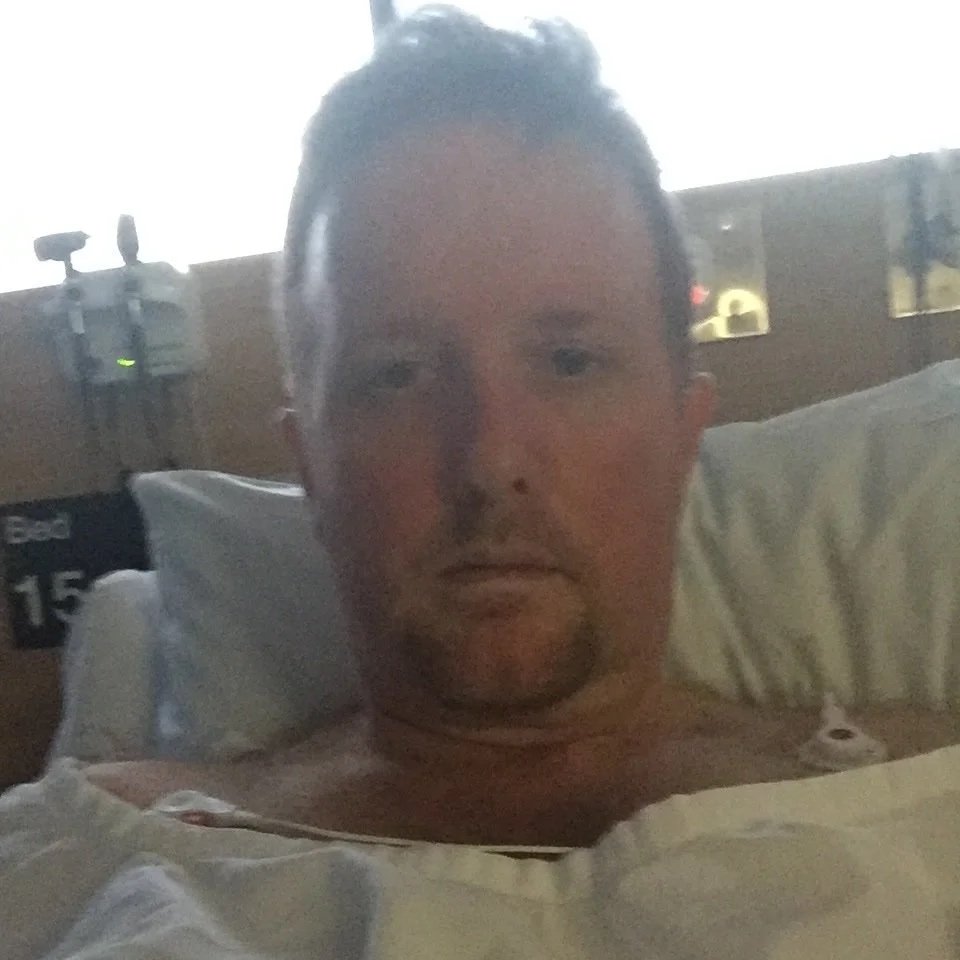
Then the car crash, my wife beside me, sternum cracking like timber. Opiates. Benzos. Adult diapers. Humiliations piling up. Years blurred: addiction tightening, psychosis circling, marriage dissolving, job gone.
I thought about who I was then, and who I had become. I wore prosthetics: food as armour, alcohol as camouflage, drugs as masks. I mirrored and performed, fat clown, drunk and loud, stoned and lit. And when the fat melted away, when the drugs and alcohol stopped, I didn’t know how to act. People didn’t know how to treat me. Thin privilege admitted me into a club I hadn’t asked to join. Who was I? Autistic rhythms, years of mirroring, years of impulsivity. Without prosthetics, without the shield, I was naked. Sober, I didn’t belong anywhere.
That was the baggage. Not just the boxes of manuscripts stacked and moulding in Kuranda, but the accidents and ghosts I had dragged north: shame, collapse, scars, masks I had worn for so long I couldn’t find the face beneath.
My destination. A cottage that waited at the end of a one-lane track called Shiva Road. Corrugated iron bruised with rust, raised on tree-stump stilts above a clearing hacked from the rainforest. Seven stairs climbed to a narrow veranda where vines pressed their faces into the windows. The guttering and downpipes were furred with lichen; the roof drummed even in light rain. The house felt spectral, suspended above the jungle floor on threads that might snap at any moment.
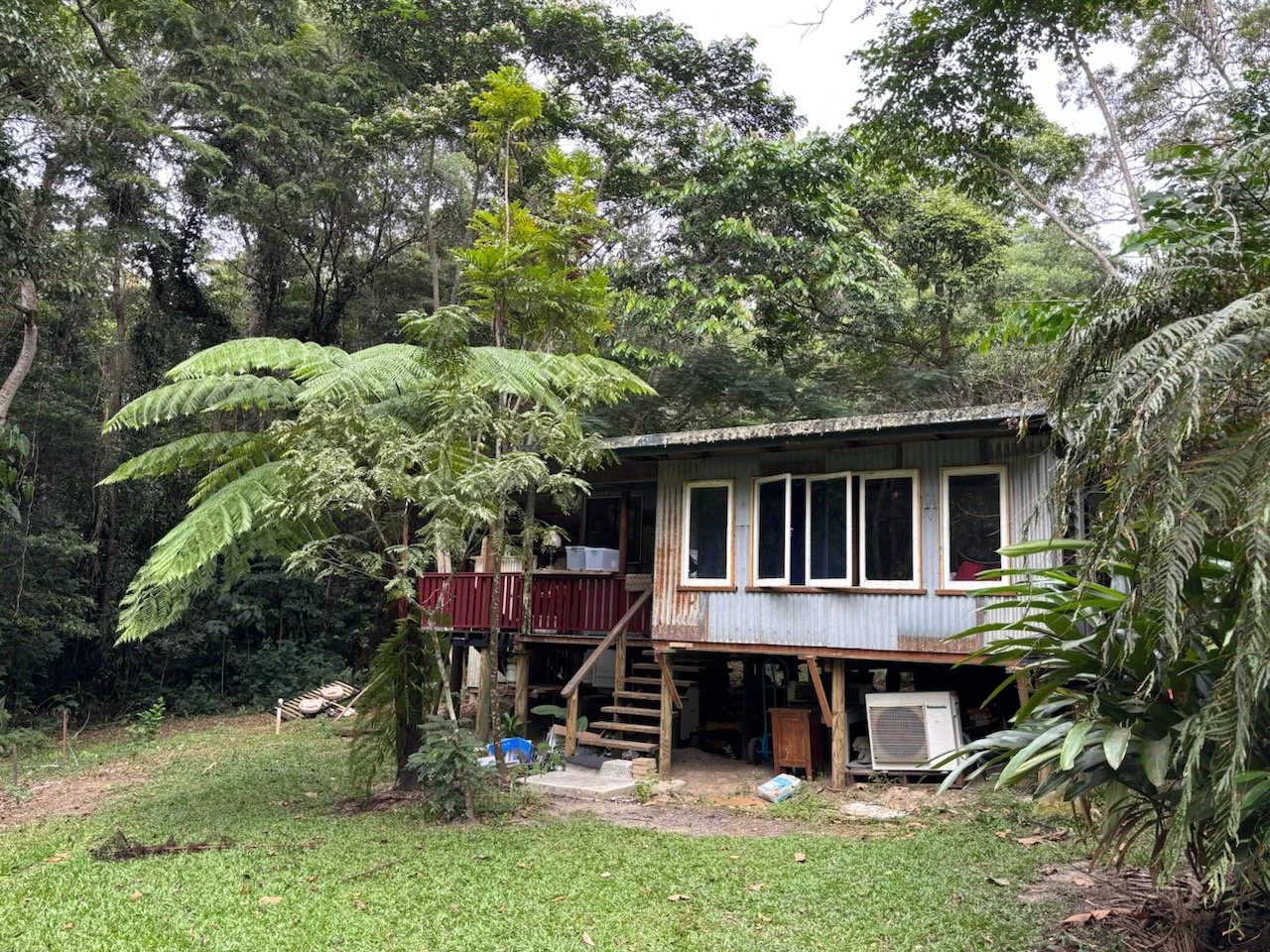
Inside, the wooden floors bowed underfoot; the fridge rattled when I walked. At night, the wind lifted from the Barron and the temperature dropped ten degrees, colder than the city below, so I wrote in a hoodie and socks whilst mist crawled under the doors. The toilet sat outside under the balcony; the shower was tacked to the back wall beneath a sheet of corrugated plastic the colour of old teeth. Water dribbled more than flowed. A burnt-orange lounge faced the forest, and when I sat there, the vines seemed to inch closer.
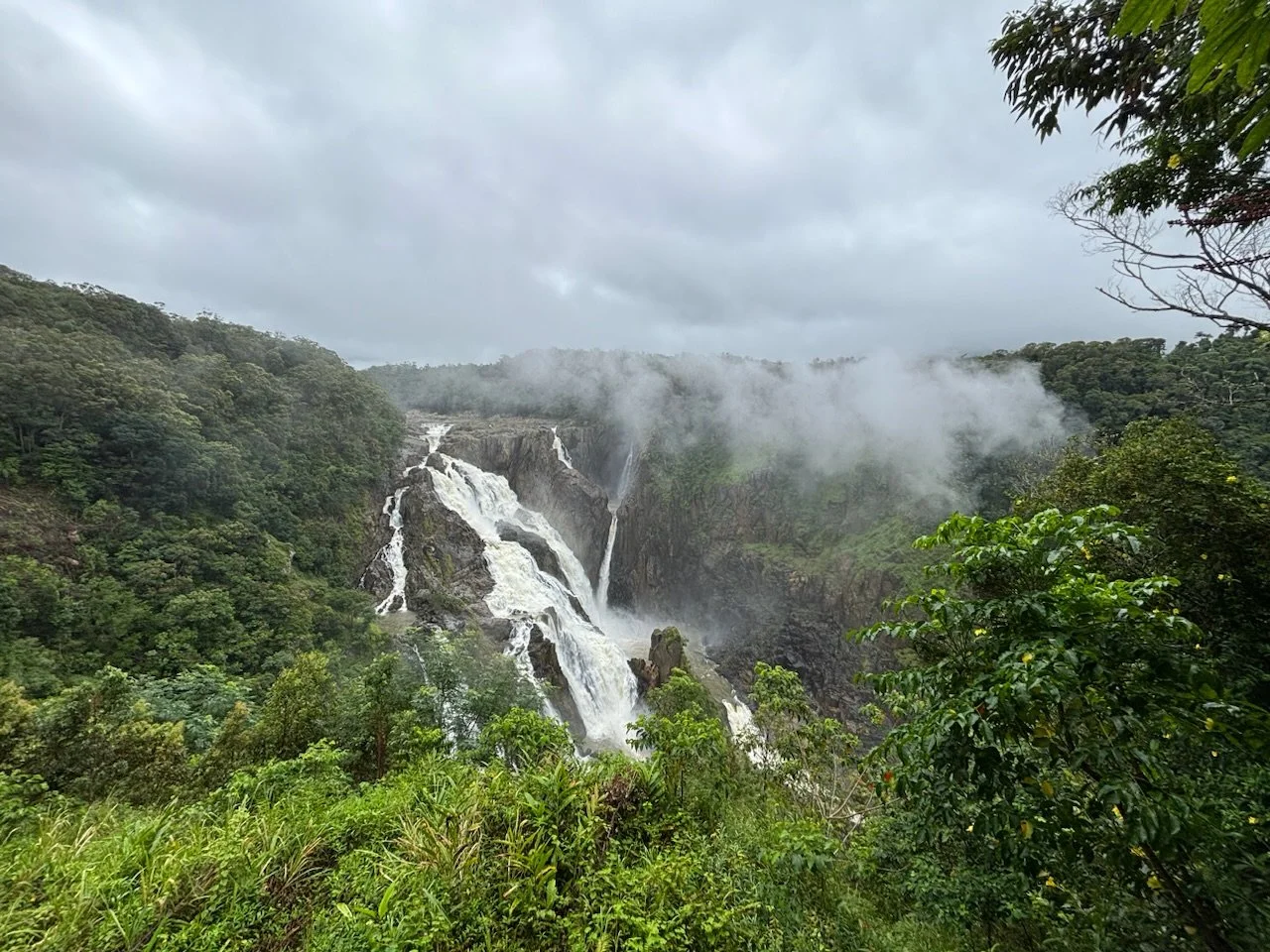
From the veranda, I could hear the Barron River. Even when invisible, it announced itself, a deep, patient roar at night, breathing through the gorge. The sound became a metronome for thought.
I told myself I’d live like Kerouac in Desolation Angels, ascetic, honest, stripped back to the page. Same mud, different altar. I had his quote, ‘You came here to write,’ pinned to the fridge.
For weeks nothing came. I scrubbed mould from the walls, boiled coffee on the gas ring, read the same sentences over and over. The manuscripts sat unopened, in two duffel bags, paper swollen with humidity. I walked the ridge and watched clouds drag their bellies across the trees. Silence became an occupation.
I was clean, sober, and thin, but my soul was broken.
I had started this manuscript back in 2016, when the weight first began to fall away. Then came the years of sickness, addiction, accidents and hospitalisations. Near death. Mystical visions from Athena. More psychologists. More diagnoses. Losing myself. Neurodivergence as another label, another fragment of identity. Psychosis. Divorce. Job loss. The fat melted away. My body, mind and spirit melted with it.
The rain was relentless. It came sideways, hammering the roof, dripping through the louvres. The air swelled until the walls perspired. Geckos hunted moths across the ceiling beams. I began to think of them as psychopomps, small spirit guides ferrying souls through heat and darkness. At night, their chirps punctuated the drone of frogs, their translucent bodies flashing under the single bulb like fleeting messengers.
The humidity distorted everything: books curled, clothes soured, thoughts softened. Days melted into one another. I dozed and woke and listened to the river. In the half-sleep between fever and silence, I saw my own history rising, the hospitals, the medications, Japan, the shame of taking up too much space, the surgeries that carved me smaller, the addiction that followed like weather.
The accident came on April 2nd, 2025. I was helping the artist, Jill Chism, unload pavers for her exhibition, Call of the Running Tide. One slipped and crushed my toe. Smashing the bone and squashing the toe in three pieces, all hanging slackly at 90-degree angles. It looked like the flesh was peeling off the bone. The pain was blinding, immediate, intense - it bled profusely. Cortisol pumped through my body, and I went into shock, threw up and started shivering and shaking. Jill drove me to Cairns Hospital where luckily a British orthopaedic surgeon was in residence. She cleaned the exposed bone and sowed the toe back together, fitting the pieces together like origami. The nail was removed, warning me of Melioidosis - a deadly bacteria in tropical soil and water, common during heavy rain. I took her seriously. I kept my toenail in a specimen jar. Where it’s still on my shrine. I wore a moon boot.
I had to remain inside, not get it wet or dirty and not move to ensure that the bone healed and didn’t need to be rebroken and reset.
When the pain eased, I drove down the range for groceries. Cairns shimmered below, humid and unreal, caught between reef and mountain. A university friend had given me a name, Martin (not his real name), someone ‘worth talking to, a fellow writer.’
He waited in a café near the centre of Cairns called Candy’s. He looked, I think, like a character from a Conrad novel: an overgrown English public-school boy posted to the edge of empire, bewildered by the climate. There was something colonial in his presentation but softened by bohemian eccentricity. If Graham Greene had imagined an academic-turned-exile, this might have been the template.
Martin taught statistics and research methodology at University. His discipline was psychology, but he carried it lightly. His voice was deliberate, slow, lips thin, movements reserved. When he spoke, it was with the precise cadence of someone used to lecturing about nuance and metaphor. He watched you as you listened, holding your gaze with patient neutrality, studying the space between question and response.
‘Hey, man,’ he said, shaking my hand. ‘I heard about your accident.’ He glanced at the moon boot. ‘From the reports, I was expecting you to be far more dissipated. You look well.’
‘You sound disappointed,’ I said. ‘I assure you, I’m not.’
We laughed. He bought two long blacks.
‘Yeah,’ I nodded. ‘It’s intense. Raw. Primal. I think I needed it. To get clean. To start again. I haven’t heard my own voice in years, and it’s …’
He waited.
‘I brought everything up with me,’ I said. ‘Thousands of pages. Early drafts. Old manuscripts. Sections from Melted. It’s overwhelming. I keep moving piles around, like furniture in my head. I thought I’d be halfway through the novel by now, but I’m stuck. It’s all there, in pieces, but no arc.’
‘Is that what you’re writing now?’
‘I’ve told everyone I’m writing it,’ I said. ‘Told work I was taking a sabbatical to finish. But I’m terrified. I haven’t written a full draft in five years. And I was high the whole time. What if I can’t do it sober?’
‘You think the drugs helped you write?’
‘They helped me start,’ I said. ‘But they never helped me finish.’
He smiled. ‘So what’s it about?’
I hesitated. ‘Radical body change. Identity. Weight loss. Addiction. Psychosis. Love. Loss. Writing. Spirituality. Myth. Recovery. But I don’t want it to be a rehab memoir. It’s about Renewal. Identity. Redemption. Faith.’
He raised an eyebrow. ‘That’s a lot.’
‘Oh, and a cottage. Kuranda. The rainforest.’
He laughed. ‘Genre?’
‘I don’t entirely know. Nine years of drafts in different voices. I’m letting it take its own form, a lyric memoir.’
‘Sounds like a confessional,’ he said.
‘It is.’
He sipped his coffee. ‘You’ve got the setup already, academic, mid-forties, leaves job, has breakdown, psychosis, moves to rainforest, tries to write. Classic mid-life-crisis novel.’
‘Fifty-three,’ I corrected.
‘I mean that in the best way,’ he said. ‘Like a postmodern, Eat Pray Love. But instead of Italy and yoga, its addiction, painkillers, DTs, and rainforests.’
I laughed. ‘Yeah. And cassowaries.’
He grinned. ‘And less enlightenment.’
The line landed softly, affectionately. The whole venture was part confession, part farce. But under the humour was something else, the sense that stories, even absurd ones, might still save us.
I confessed that I didn’t know where to start: the accident, the operations, the hospital rooms, the overwork, the divorce. All of it blurred into a single unfinished sentence.
We talked about the north, the gravity it exerts on people who don’t fit elsewhere. ‘Cairns is full of exiles,’ he said. ‘People who come here to disappear or to begin again.’ He grinned. ‘You, my friend, might be the first to try both at once.’
He continued, ‘Cairns has always been a place for exiles and outsiders. Have you noticed no one is actually from here? Ninety percent are from Melbourne, refugees from the cold or from their own lives.’ He spoke of waves of migration: cane-cutters, islanders, Chinese gold miners, Greeks, Italians, Sicilians, Hungarians, Lebanese. ‘People looking to escape, to reinvent, to run from the cold or from lives that no longer fit.’
He adjusted his fedora. ‘I have a theory. When everything collapses, marriage, career, identity, we start arranging fragments. We build a story out of what’s left.’
‘You think that’s what I’m doing?’
He smiled. ‘I think that’s what writing is.’
He leaned forward. ‘Two ways,’ he said. ‘Gradually, then suddenly.’
‘In a real dark night of the soul, it is always three o’clock in the morning,’ I answered, quoting Fitzgerald.
He nodded approval. ‘You want the hut and the page, good,’ he said, echoing Kerouac. ‘Now suffer for it.’
When I stood to leave, Martin nodded once. ‘Write it all down,’ he said. ‘That’s how we pay our passage.’
Driving back up the range, the clouds folded in around the car. The dragons slept again in the mist. His words followed me like a benediction.
Back at the cottage, I wrote my first paragraph. It wasn’t good, but it was honest. The rainforest pulsed against the tin walls. Every sound was magnified, the drip of water, the call of curlews, the steady breathing of the river. Writing felt less like creation and more like transcription, as if I were taking dictation from the place itself.
Some nights, the rain slowed to a whisper and the forest held its breath. I would step onto the veranda and watch the geckos patrol the railings. The Barron’s roar deepened, the air thick with the smell of wet bark and rotting leaves. In those moments, I understood that the rainforest wasn’t a backdrop but a mind, its own vast nervous system of growth and decay. I was simply another pulse moving through it.
The weeks blurred. The foot healed. The fever left. I walked again without pain, tracing the river’s curve where it vanished into gorge. The rainforest mirrored everything I brought to it, fear, ambition, the need for absolution. It mirrored my neurodivergence, the quicksilver attention and the sudden collapse. It showed me that the rhythm I’d mistaken for a disorder was just another form of life.
Writing returned in fragments. A line about rain, a paragraph about silence. I learned that sentences could breathe. I stopped punishing myself for pauses. The rainforest taught me to work in pulses: write, wait, listen.
When I looked back on the drive north, I saw not a journey but a shedding. Each kilometre had peeled away another version of me until only the writer remained, uncertain but intact. I thought of Martin and his café sermon, of the exiles who come here to disappear and to begin again. Maybe the difference between the two was only the story we tell.
The dragons around Cairns lifted their heads in the mist. The air smelled of tin and lightning.
At night, I sat beneath the single bulb, listening to rain on the roof, feeling the pulse of the forest press against the walls. The words came faster, then slower, then stopped. That was fine. The story was teaching me patience.
The Barron still flooded; the curlews still cried. The rainforest still hummed with its patient, untranslatable language. And I was still there, writing.
‘We tell ourselves stories in order to live.’ Joan Didion
This essay is excerpted from the forthcoming memoir, Melted, by Vogel-shortlisted author, Jeremy Aitken.
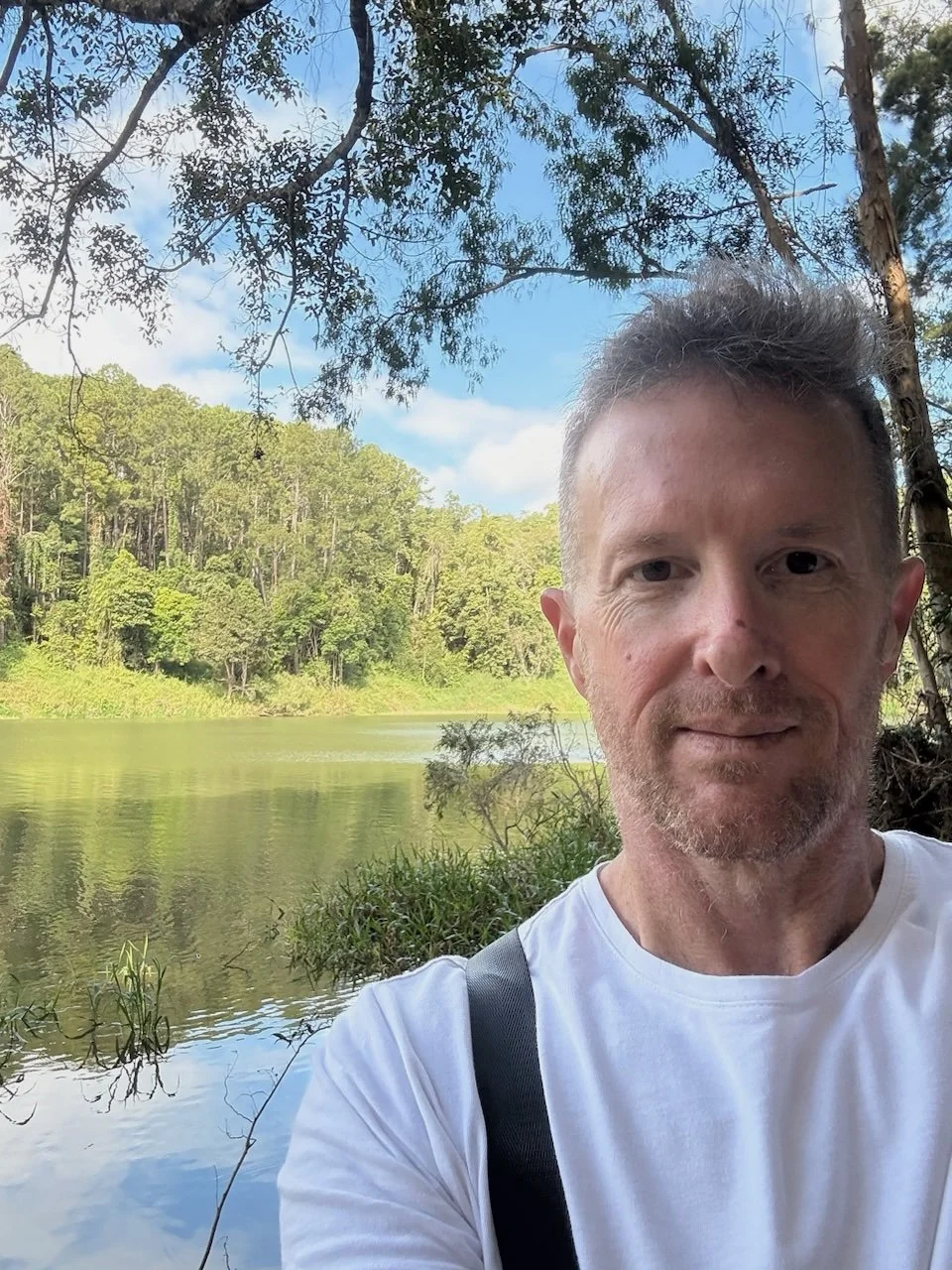
Jeremy Aitken is a Vogel-shortlisted author of The Bike and a lecturer in Human Services and Sustainability at the Australian College of Applied Professions (ACAP). His teaching centres on reflective practice, cultural safety, and ethical decision-making in professional contexts. Based in Kuranda, Far North Queensland, Jeremy’s debut novel Crystal Street(2017) explores addiction and transformation. His forthcoming memoir, Melted, traces collapse and renewal across body, mind, and rainforest, blending confessional narrative with close ecological attention.
For updates on Melted, follow Jeremy on Instagram @jezzaaitken.